 · Commodore 128
Mappy on the Commodore 128, no REU needed
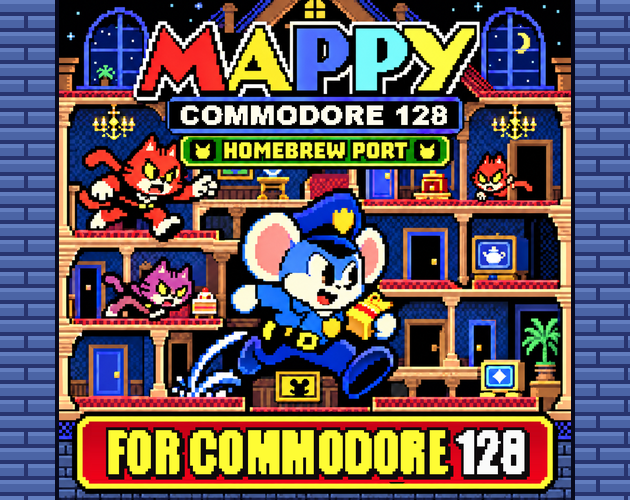
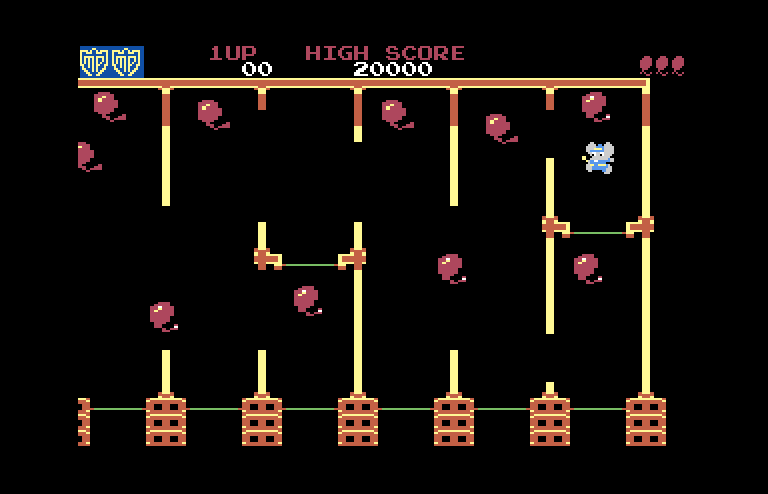
Mappy, the 1983 Namco arcade game, now runs on the Commodore 128 too: a stock C128, in C128 mode, on the 40-column screen. This time no REU is needed, and no other expansion either. It is the same game as the C64 version, with the same engine: the sixteen houses, the bonus rounds with the balloons, HURRY, Goro and the Gosenzo coin, the TOP 5.
The second bank instead of the REU. On the C64 the houses, the music and the screens live in the REU. The C128 has 128 KB in two banks of 64: the second one holds the sixteen houses, the music, the sound effects, the screens and the bonus round.
The arcade's speed on PAL too. In the screen borders the C128 can run at 2 MHz, twice the C64, and those extra cycles go to the game. On PAL machines that is enough for 60 game ticks a second, six every five frames, as on the arcade board; the C64 version runs at 50 on PAL. On NTSC it is one tick every frame, as on the arcade. The house always scrolls a pixel at a time, at 60 frames a second on NTSC and 50 on PAL.
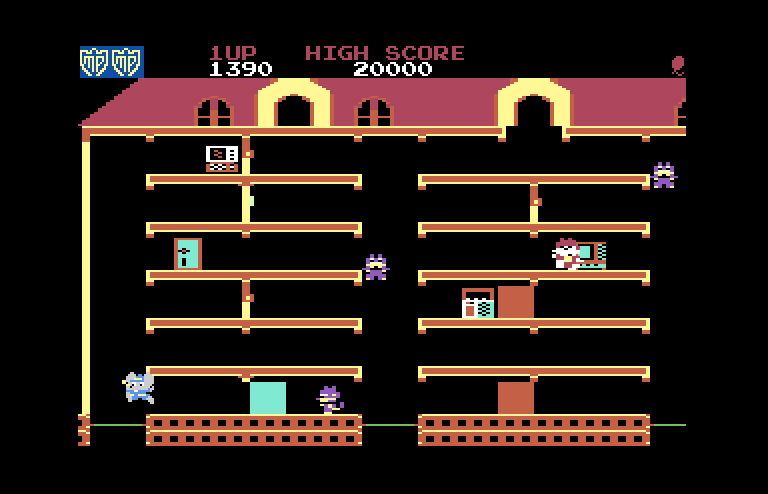
Taking turns in a crowd. The Commodore's video chip shows at most eight sprites on the same line, and two of them are Mappy. When more than six enemies crowd a floor, they take turns: none of them stays invisible for more than a frame.
The sound. As on the C64: for the arcade's sound effects in full you need a second SID, at $D420. The game finds it by itself when it starts and plays the effects on it, whole, while the music keeps all three of its voices. With one SID the game works all the same, but an effect borrows the music's third voice and only its main part is heard.
Play it from the disk (.d64: in C128 mode, RUN"MAPPY") or from the cartridge (.crt), which starts by itself at power-on; the same files work on PAL and NTSC. Joystick in port 2, or W A S D and space. I tested it in VICE (x128), not yet on a real C128: if you try it on real hardware, tell me how it goes.